Designer & Creative director
Designer & Creative director
Personalized stock and crypto recommendations tailored to user behavior
and portfolio goals
Personalized stock and crypto recommendations tailored to user behavior and portfolio goals
Zentra is a conceptual mobile fintech app (feature) designed to empower everyday users with personalized, ethical financial tools. In a world where traditional banking feels outdated and overwhelming, Zentra bridges the gap by integrating AI-driven insights, sustainable investing, and seamless protections, all in one intuitive platform. Built as a project to showcase innovative product design, it draws inspiration from apps like Revolut while addressing 2025 trends like AI transparency.
The Problem
Modern fintech users, like our persona Mark, a 32-year-old software engineer juggling investments and sustainability goals, face fragmented experiences. They switch between apps for transactions, advice, and eco-options, leading to decision fatigue and missed opportunities. Research revealed key gaps: 68% demand AI personalization but 58% distrust it due to opacity; 70% seek purposeful finance amid climate concerns. Without holistic tools, users like Mark risk inefficient portfolios and overlooked risks.
Key challenges identified
Overwhelmed by data silos in investing and budgeting.
Lack of transparent, value-aligned recommendations.
Inadequate integration of emerging needs.
Understanding the Fintech Landscape
To kick off Zentra, I dove into secondary research to map the current state of fintech in 2025. Drawing from industry reports (e.g., Deloitte's Fintech Trends 2025 and McKinsey's AI in Banking), I analyzed market gaps: While apps like Revolut excel at transactions, users crave deeper personalization amid economic volatility and climate concerns—e.g., 68% of millennials want AI for financial advice, but only 42% trust it due to privacy fears. Competitive audits of 5 apps (Revolut, Chime, Robinhood) revealed strengths in speed but weaknesses in holistic wellness and sustainability integration.
Key Insight from Discovery
Sustainability as a hook: 55% of users under 35 prioritize ESG investments.
Opportunity: AI personalization could boost retention by 25%, per Juniper Research.
Understanding the Fintech Landscape
To kick off Zentra, I dove into secondary research to map the current state of fintech in 2025. Drawing from industry reports (e.g., Deloitte's Fintech Trends 2025 and McKinsey's AI in Banking), I analyzed market gaps: While apps like Revolut excel at transactions, users crave deeper personalization amid economic volatility and climate concerns—e.g., 68% of millennials want AI for financial advice, but only 42% trust it due to privacy fears. Competitive audits of 5 apps (Revolut, Chime, Robinhood) revealed strengths in speed but weaknesses in holistic wellness and sustainability integration.
Key Insights from Discovery
Rising demand for "embedded" services (e.g., insurance in-app) post-2024 cyber spikes.
Sustainability as a hook: 55% of users under 35 prioritize ESG investments.
Opportunity: AI personalization could boost retention by 25%, per Juniper Research.
Gen Z Demand for AI Personalization (86%)
Gen Z Demand for AI Personalization (86%)
Brands Planning Personalized Rewards (80%)
Brands Planning Personalized Rewards (80%)
Organizations Scaling AI for Experiences (44%)
Organizations Scaling AI for Experiences (44%)
AI-Driven Customer Uptake Gains (35%)
AI-Driven Customer Uptake Gains (35%)
Data compiled from 2025 fintech reports on AI trends, personalization, and trust metrics
Data compiled from 2025 fintech reports on AI trends, personalization, and trust metrics
Gathering Real Voices
I conducted primary research with 13 participants (recruited via LinkedIn and X ) through 45-minute semi-structured interviews and a 10-question survey (response rate: 80%). Participants were diverse: 60% aged 21-35, 50% urban professionals, 40% with crypto exposure. Questions probed pain points like "How do you decide on investments?" and "What frustrates you about current apps?" Sessions were recorded (with consent) and affinity-mapped in the traditional way (pencil and paper) for themes.
Methods Breakdown:
Interviews: 13 one-on-ones, focusing on behaviors (e.g., "Walk me through your last investment").
Surveys: Quantified needs (e.g., 72% want AI budgeting, 65% seek green options).
Synthesis: Coded responses into 3 core themes: Overwhelm from data, lack of trust in AI, desire for ethical impact.
Targeted 13 participants via LinkedIn and fintech forums; criteria: 21-35 age range, mix of stock/crypto users, urban professionals. Yielded 80% qualified leads through screening questions on financial app usage.
Goal: Represent personas like Mark (tech-savvy millennial) to uncover real pain points in personalization and sustainability
Conducted 15 semi-structured interviews (45 mins each) probing behaviors like investment decisions; 10-question survey to 20 respondents (80% response rate) quantifying needs (e.g., 72% want AI insights).
Key tools: Google meet for recordings, Google Forms for surveys.
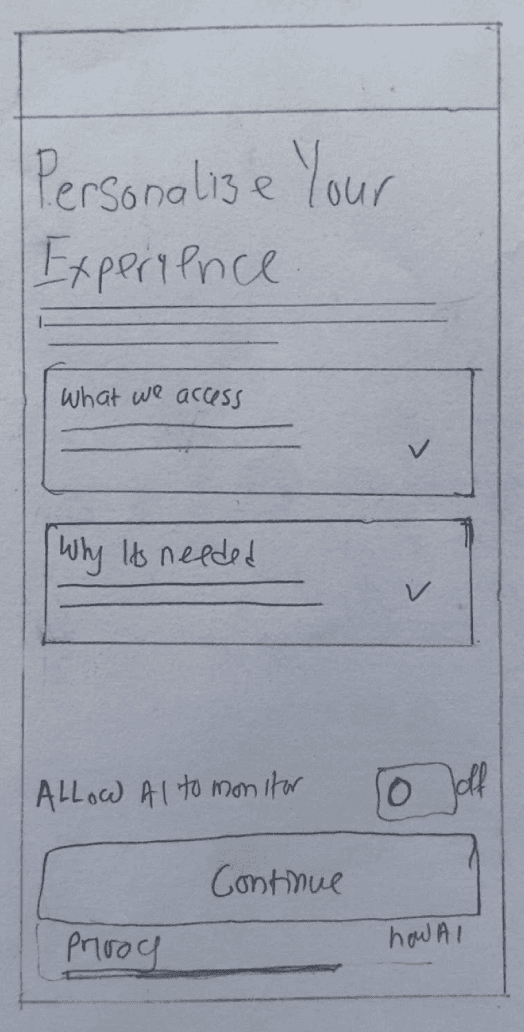
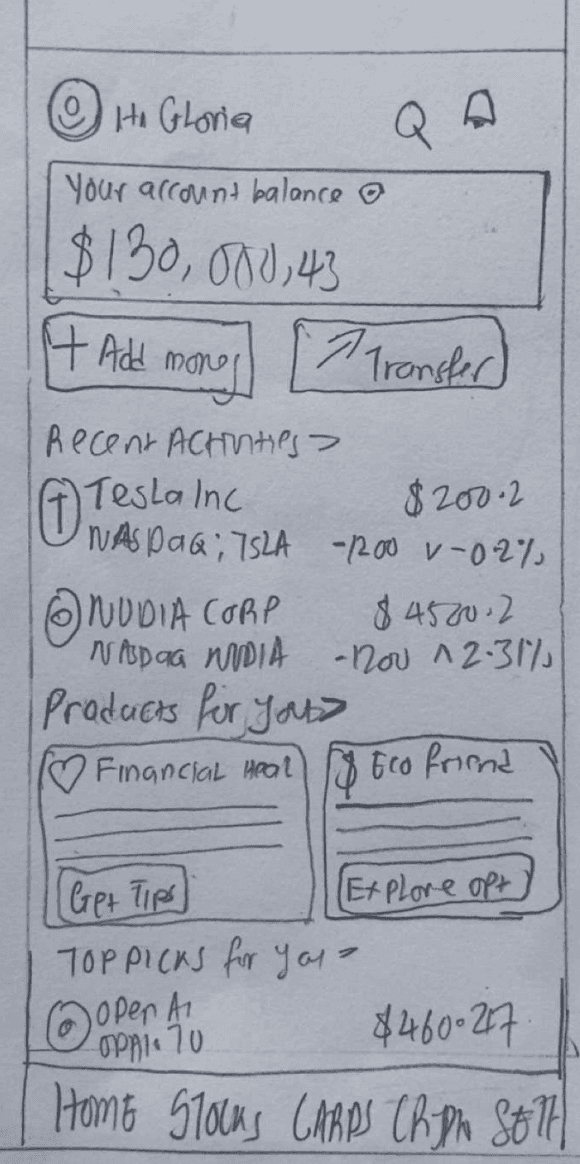
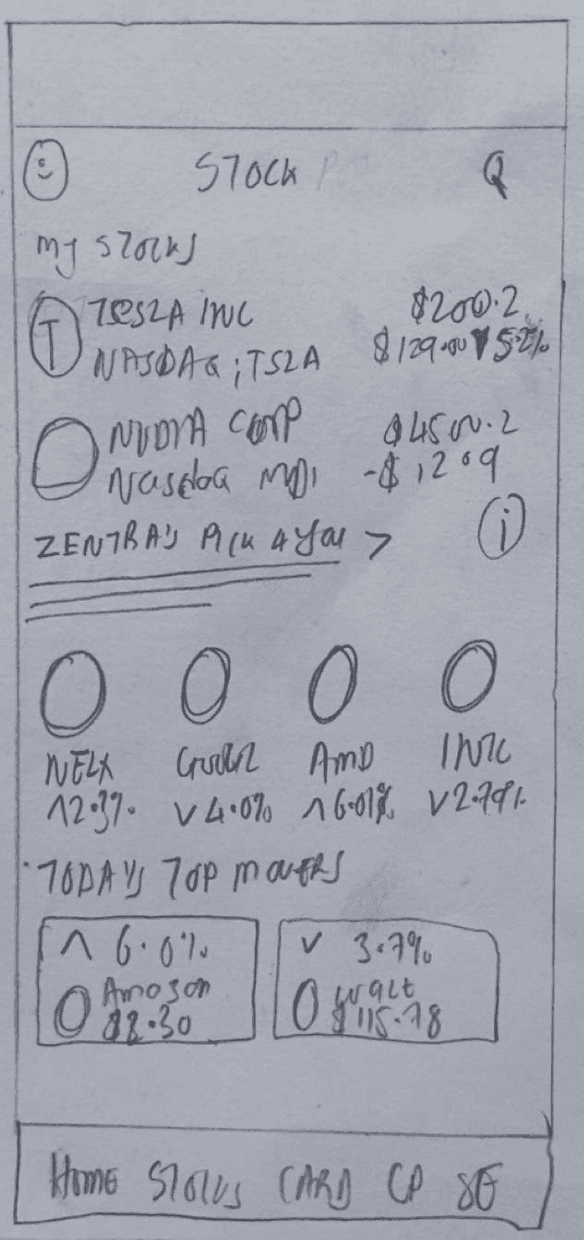
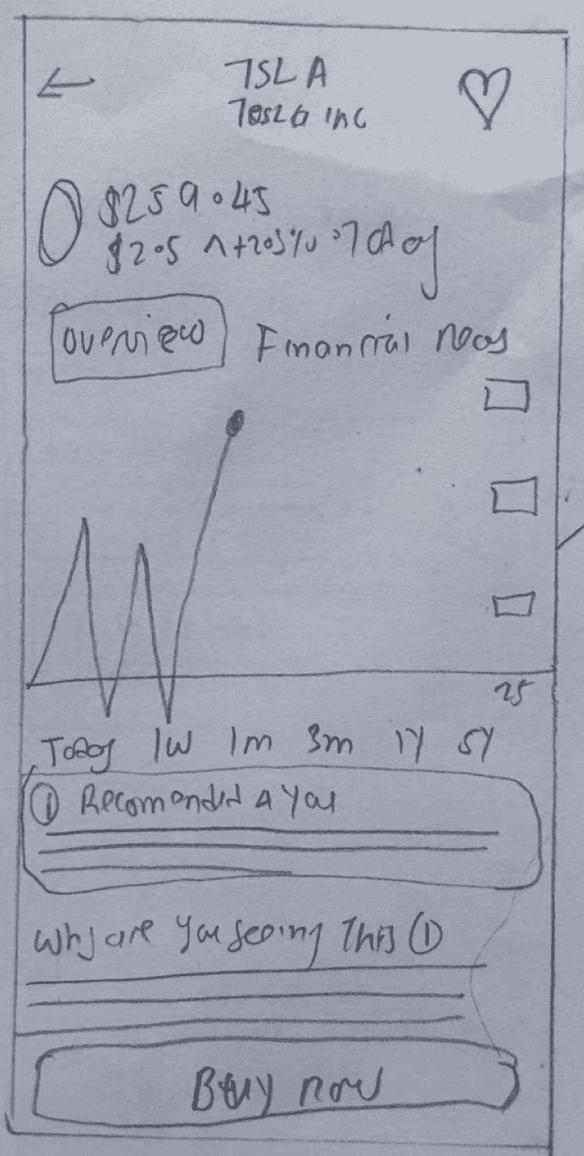
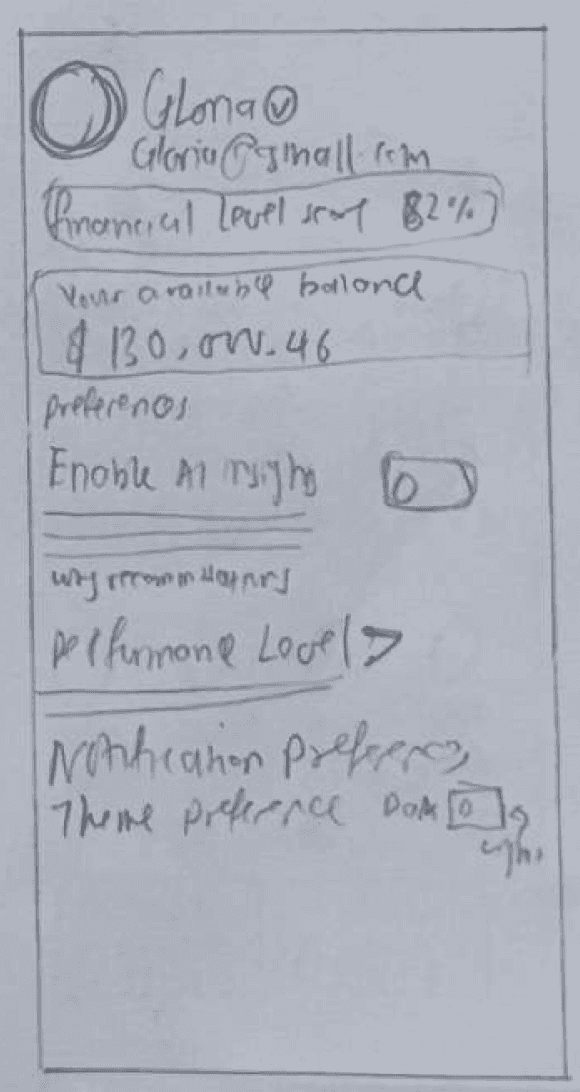
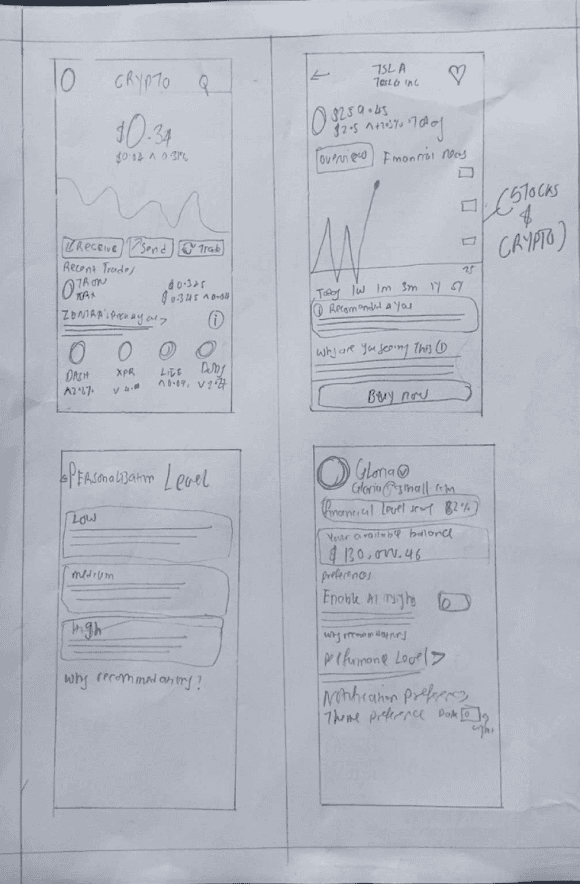
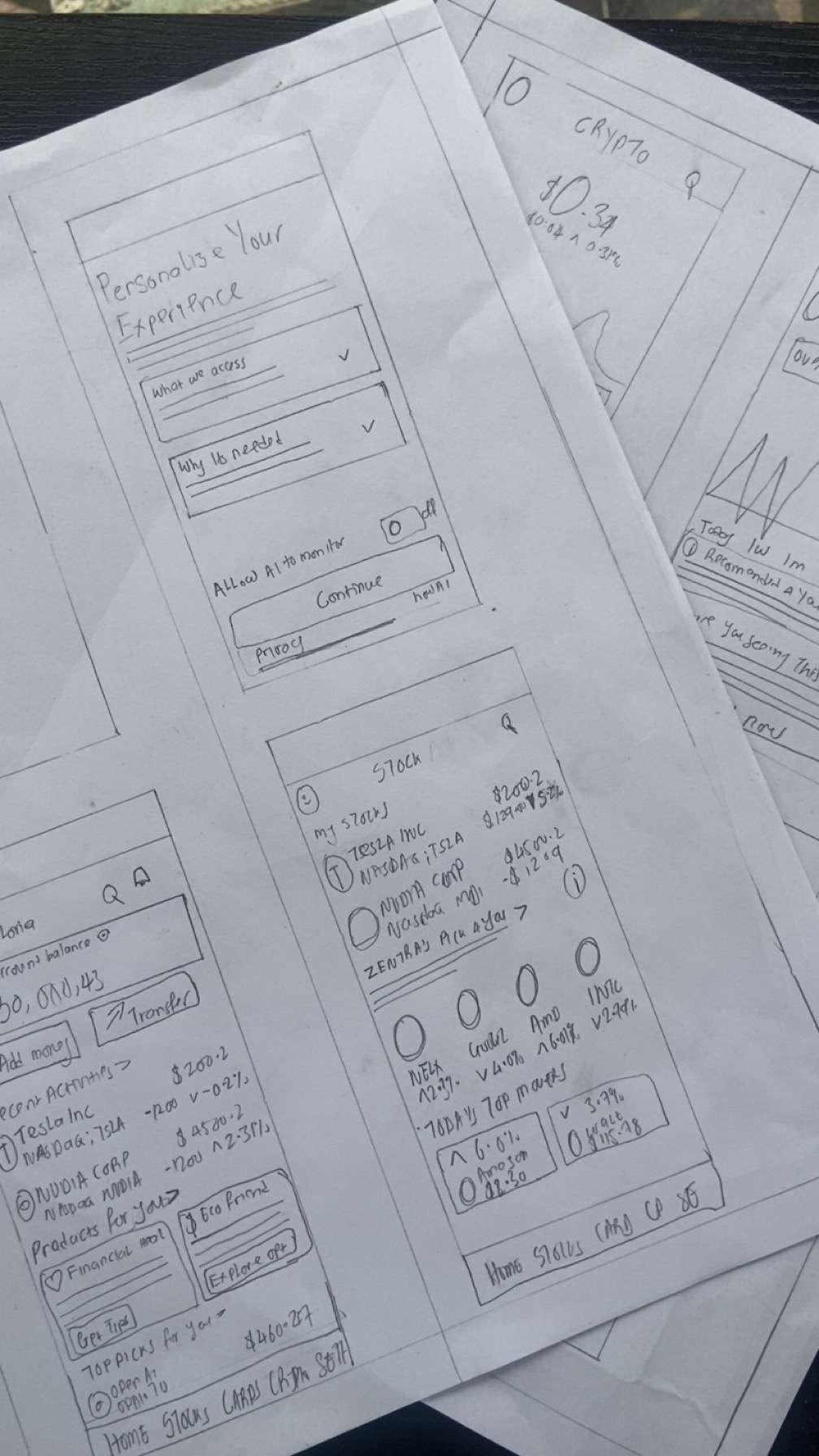
Used the traditional wireframe way (pencil and paper) boards for affinity mapping: Breaking down the notes from the interviews to get the ideas for the wireframes, making sure things are avoided and included, like; overload, trust, purpose. Resulted in the main screens and designs these interviews came to be. The persona details it well.
Targeted 13 participants via LinkedIn and fintech forums; criteria: 21-35 age range, mix of stock/crypto users, urban professionals. Yielded 80% qualified leads through screening questions on financial app usage.
Goal: Represent personas like Mark (tech-savvy millennial) to uncover real pain points in personalization and sustainability
Targeted 13 participants via LinkedIn and fintech forums; criteria: 21-35 age range, mix of stock/crypto users, urban professionals. Yielded 80% qualified leads through screening questions on financial app usage.
Goal: Represent personas like Mark (tech-savvy millennial) to uncover real pain points in personalization and sustainability
Conducted 15 semi-structured interviews (45 mins each) probing behaviors like investment decisions; 10-question survey to 20 respondents (80% response rate) quantifying needs (e.g., 72% want AI insights).
Key tools: Google meet for recordings, Google Forms for surveys.
Conducted 15 semi-structured interviews (45 mins each) probing behaviors like investment decisions; 10-question survey to 20 respondents (80% response rate) quantifying needs (e.g., 72% want AI insights).
Key tools: Google meet for recordings, Google Forms for surveys.
Used the traditional wireframe way (pencil and paper) boards for affinity mapping: Breaking down the notes from the interviews to get the ideas for the wireframes, making sure things are avoided and included, like; overload, trust, purpose. Resulted in the main screens and designs these interviews came to be. The persona details it well.
Used the traditional wireframe way (pencil and paper) boards for affinity mapping: Breaking down the notes from the interviews to get the ideas for the wireframes, making sure things are avoided and included, like; overload, trust, purpose. Resulted in the main screens and designs these interviews came to be. The persona details it well.
Pain Points and Opportunities
From synthesis, three emergent themes highlighted gaps in existing fintech tools. Users like Mark feel empowered yet anxious, wanting tools that "feel like a smart friend, not a sales pitch." These findings directly informed feature prioritization, like AI transparency.
Methods Breakdown:
Data Overload in Decision-Making
80% of interviewees struggled with fragmented info (e.g., "I check 3 apps for one investment").
Opportunity: Consolidated AI insights to reduce cognitive load.
Trust Gaps in Personalization
62% feared data misuse; quotes like "AI knows too much, but not enough about me."
Opportunity: Explainable AI (e.g., "Why this section?") to build confidence.
Straight to the
point Mark
Straight to the
point Mark
Straight to the
point Mark
Urban software engineer in San Francisco; $95K salary; single, active on X for finance tips.
Urban software engineer in San Francisco; $95K salary; single, active on X for finance tips.
Urban software engineer in San Francisco; $95K salary; single, active on X for finance tips.
Checks Robinhood daily but switches apps for crypto; tracks carbon footprint via a separate tool; prefers voice notes for quick budgets.
Checks Robinhood daily but switches apps for crypto; tracks carbon footprint via a separate tool; prefers voice notes for quick budgets.
Checks Robinhood daily but switches apps for crypto; tracks carbon footprint via a separate tool; prefers voice notes for quick budgets.
Build a diversified portfolio with 20% green assets; get proactive alerts without spam.
Build a diversified portfolio with 20% green assets; get proactive alerts without spam.
Build a diversified portfolio with 20% green assets; get proactive alerts without spam.
I invest impulsively because options feel endless—need something that 'gets' my risk style
I invest impulsively because options feel endless—need something that 'gets' my risk style
I invest impulsively because options feel endless—need something that 'gets' my risk style
Make my money work for my peace of mind, not just my bank account
Make my money work for my peace of mind, not just my bank account
Make my money work for my peace of mind, not just my bank account
This persona was made to guide me with a clear, concentrated focus and to maintain consistency in design decisions.
This persona was made to guide me with a clear, concentrated focus and to maintain consistency in design decisions.
This persona was made to guide me with a clear, concentrated focus and to maintain consistency in design decisions.
Ideation: Wireframes: Structuring the User Experience
Translating research insights into low-fidelity blueprints, ensuring seamless navigation for personalized features like AI insights and sustainable recommendations
High-Fidelity : Polishing the Vision:
Elevating wireframes into vibrant, interactive mocks, with annotations and descriptions for each key screen to demonstrate seamless fintech flows and ethical innovations.
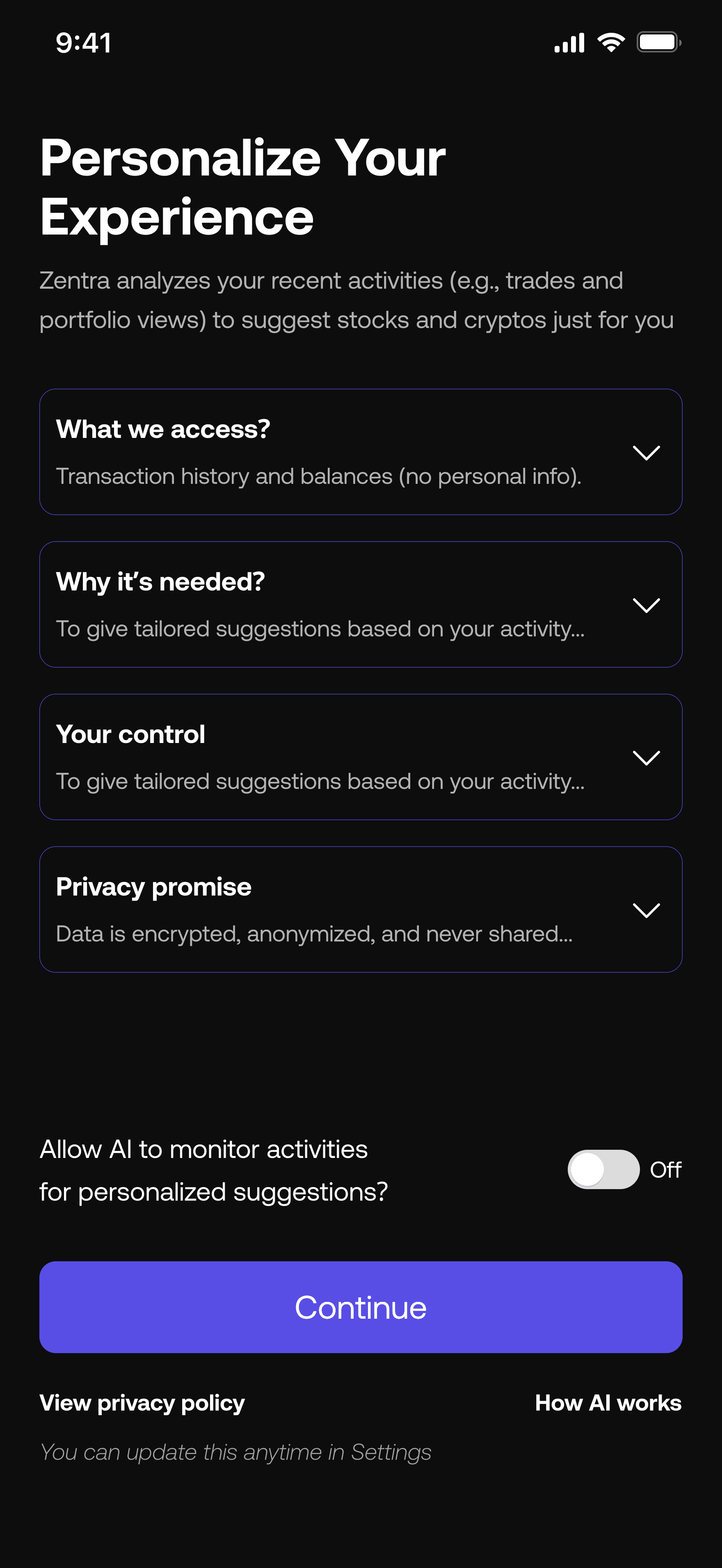
In a bid not to let the users work in the dark the last screen of the onboarding is where they will see the toggle to activate the AI assistant and the details as to what it is all about
AI activation toggle, default off (can be changed at any time on the settings page)
Suggested assets to invest in by Zentra AI
A list of other tools available also empowered by AI
Suggested Stocks recommended based on recent activities
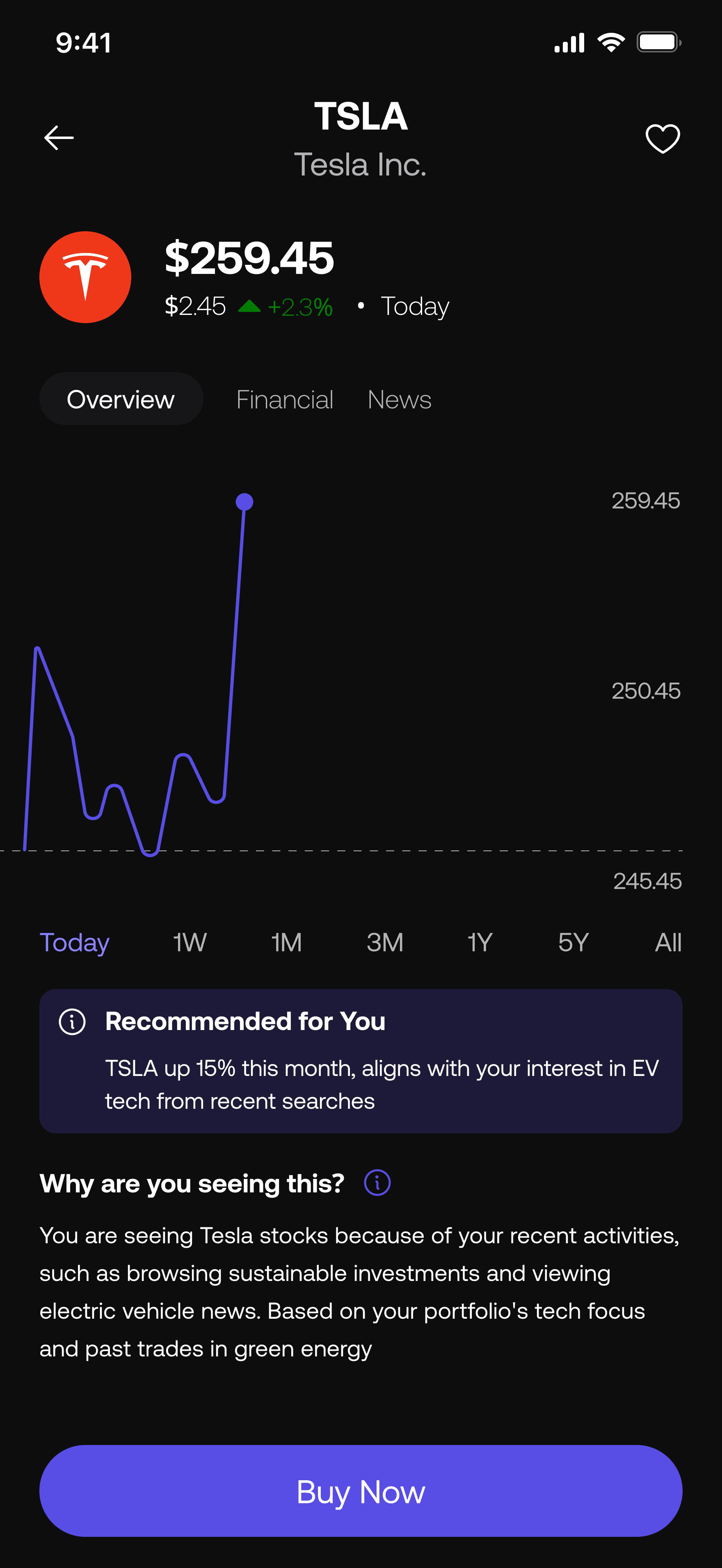
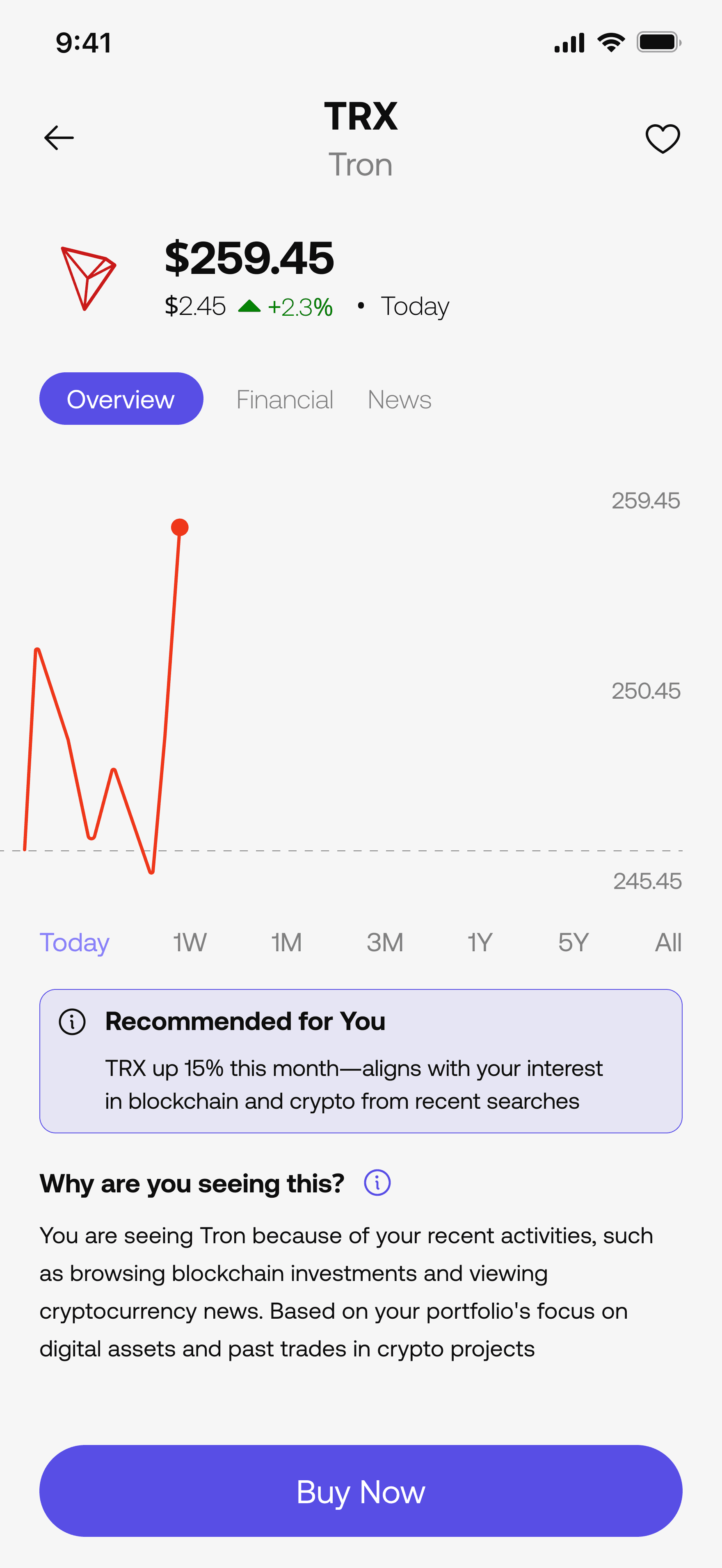
Crypto/Stocks details page
Explanation for why that particular stock/crypto was recommended
AI activation toggle, can be switched on and off at any time
In a bid not to let the users work in the dark the last screen of the onboarding is where they will see the toggle to activate the AI assistant and the details as to what it is all about
AI activation toggle, default off (can be changed at any time on the settings page)
Suggested assets to invest in by Zentra AI
A list of other tools available also empowered by AI
Suggested Stocks recommended based on recent activities
Crypto/Stocks details page
Explanation for why that particular stock/crypto was recommended
AI activation toggle, can be switched on and off at any time
Onboarding and Data permission page
This answers the users questions, with relation to the reason for the AI personalization permission
AI activation toggle, default off (can be changed at any time on the settings page)
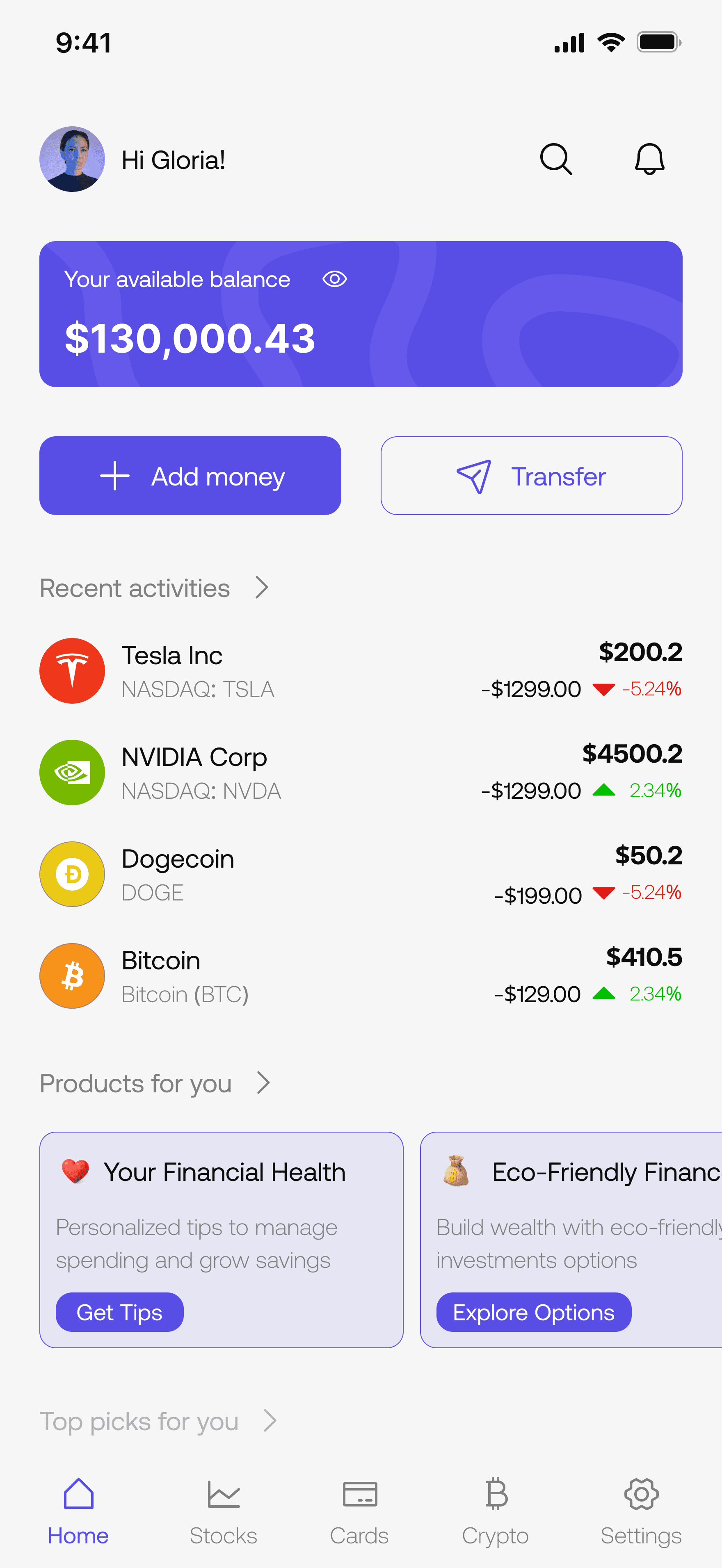
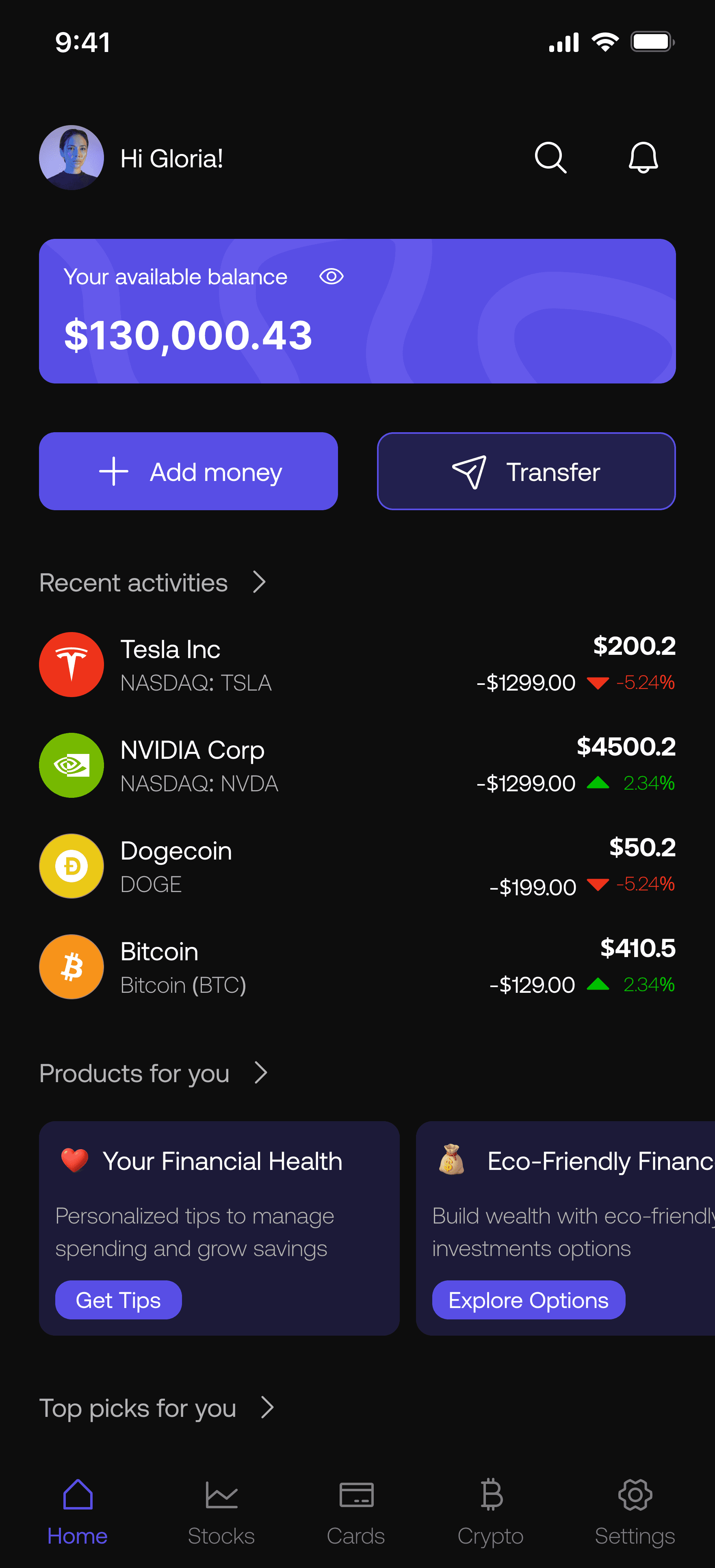
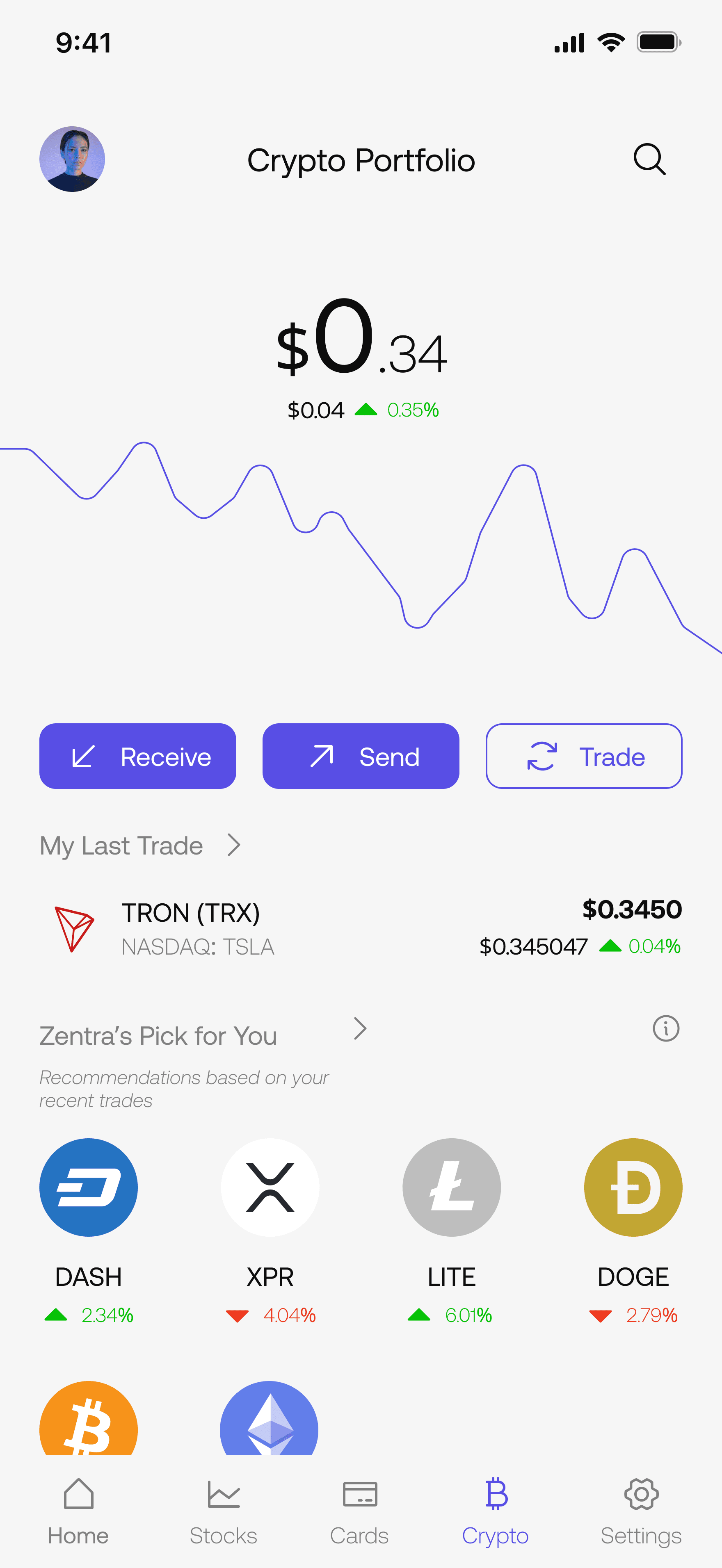
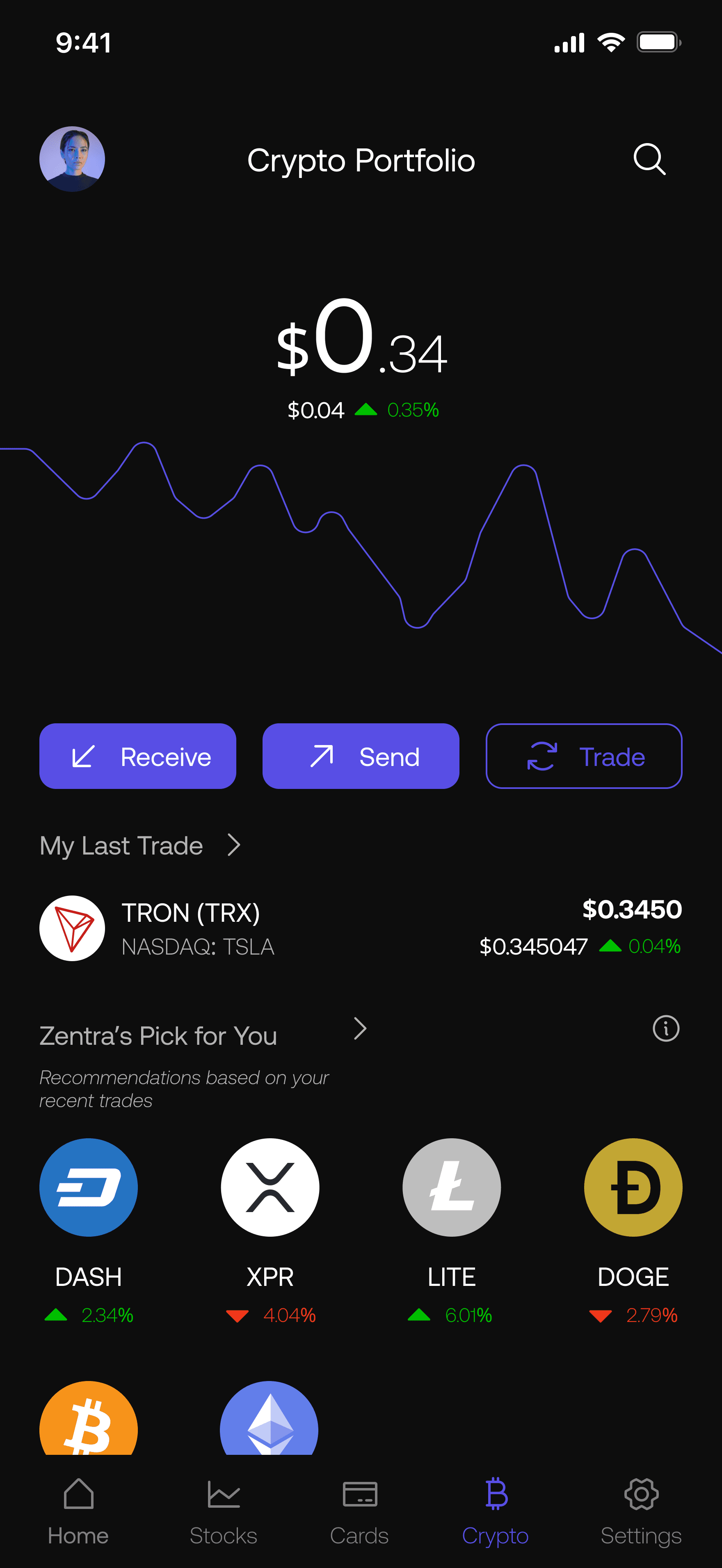
The core dashboard integrates transactions, investment picks for you, and the “Products For You" module with widgets.
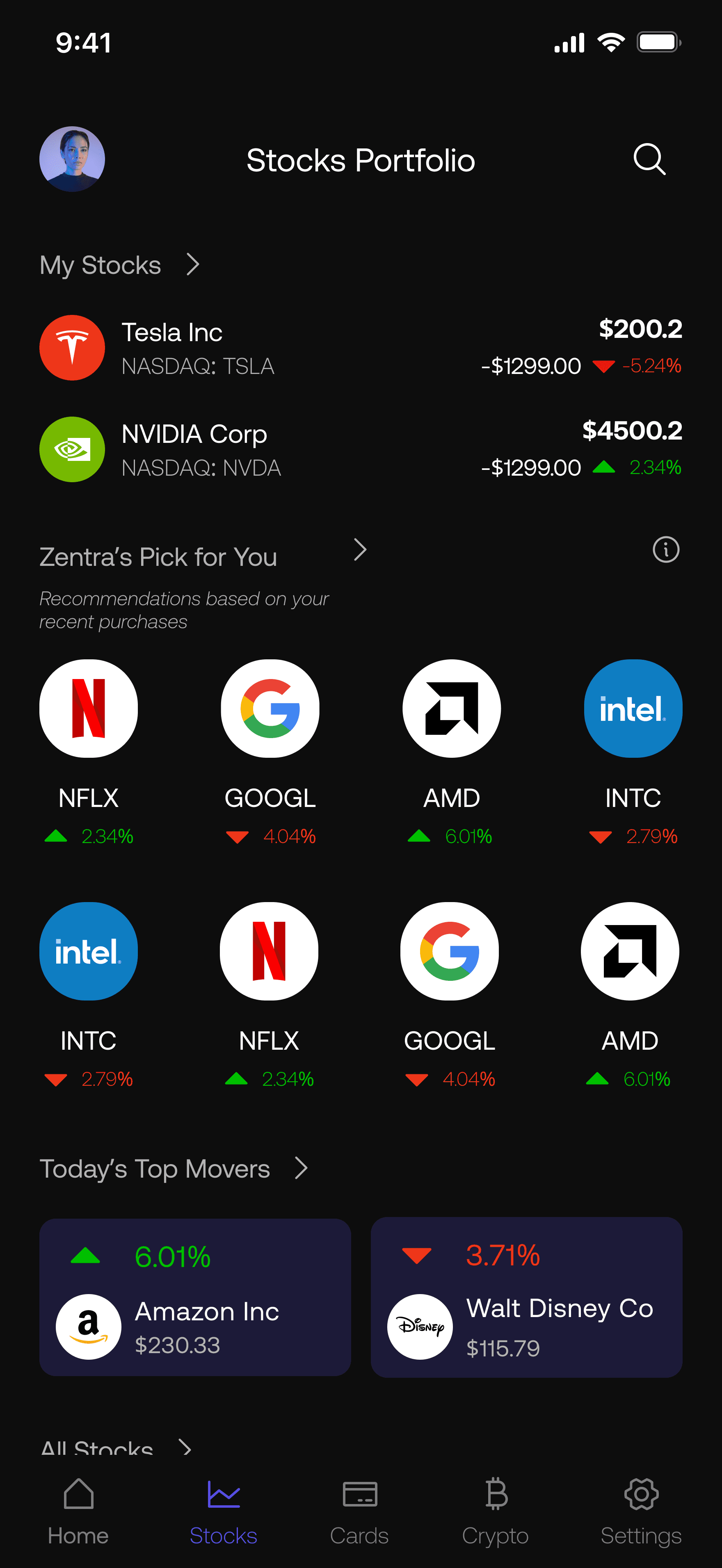
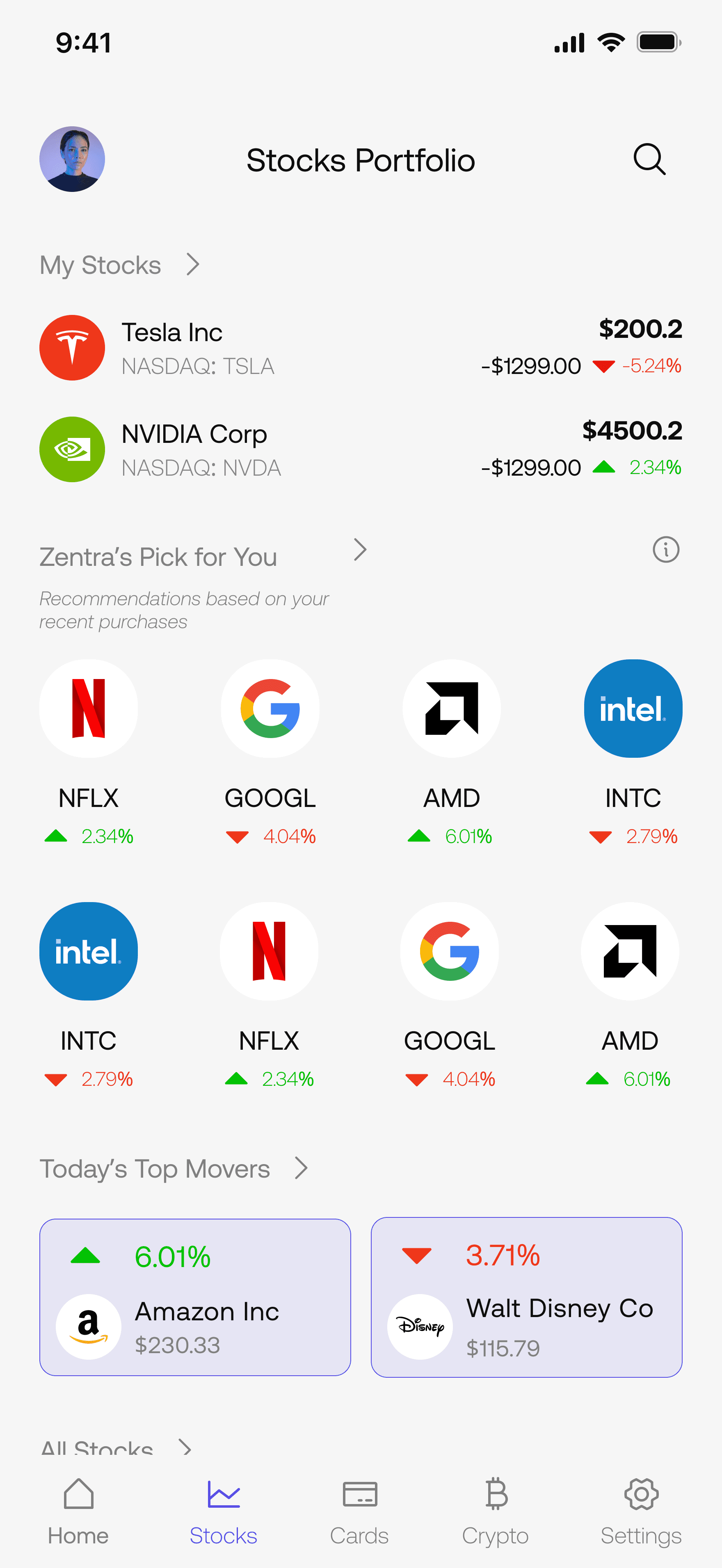
These are the recommended stocks Zentra gave, based on the users activity on the platform.
These are the recommended crypto Zentra gave, based on the users activity on the platform.
Focused on informed decisions, this screen features real-time charts, key stats, and the explainable AI section "Why You're Seeing This" (e.g., "Based on your interest in similar asstes").
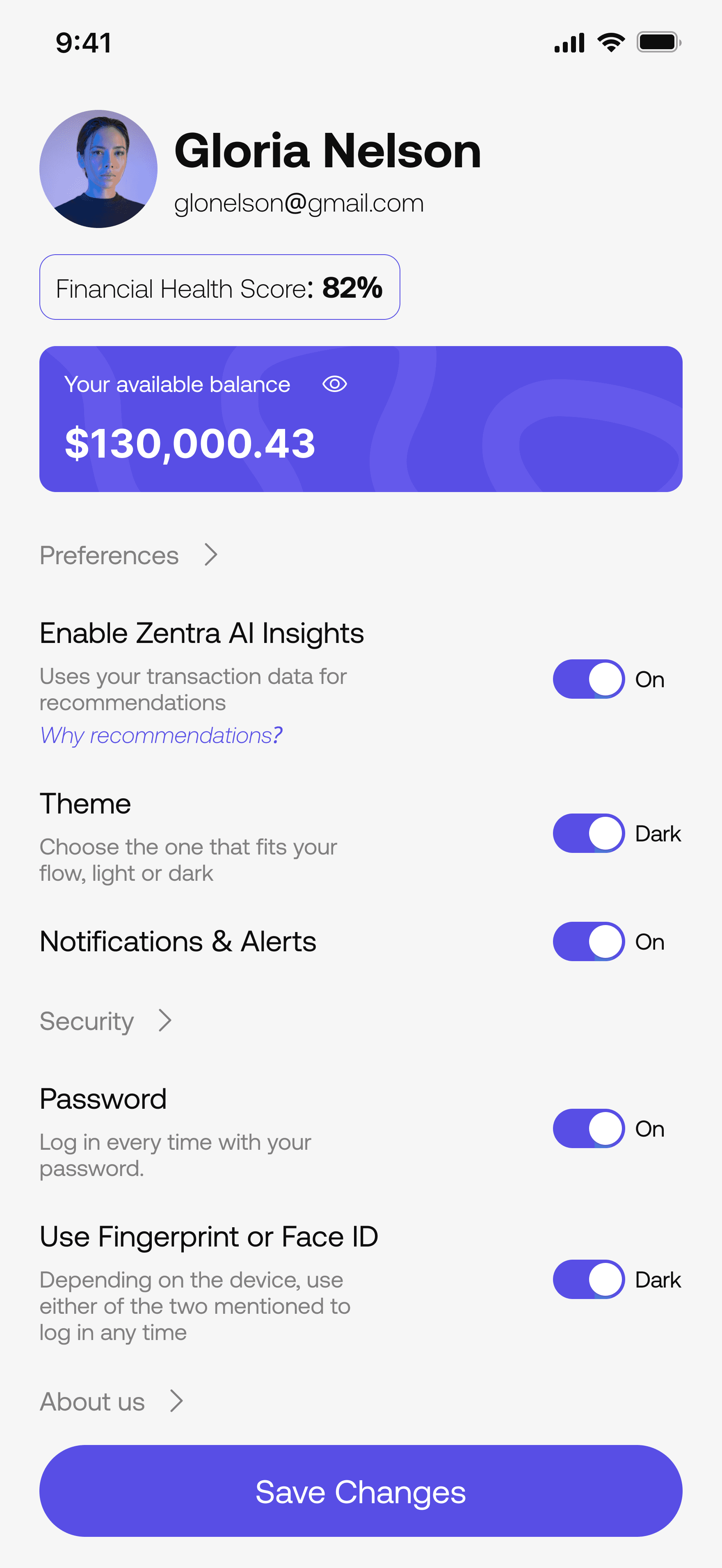
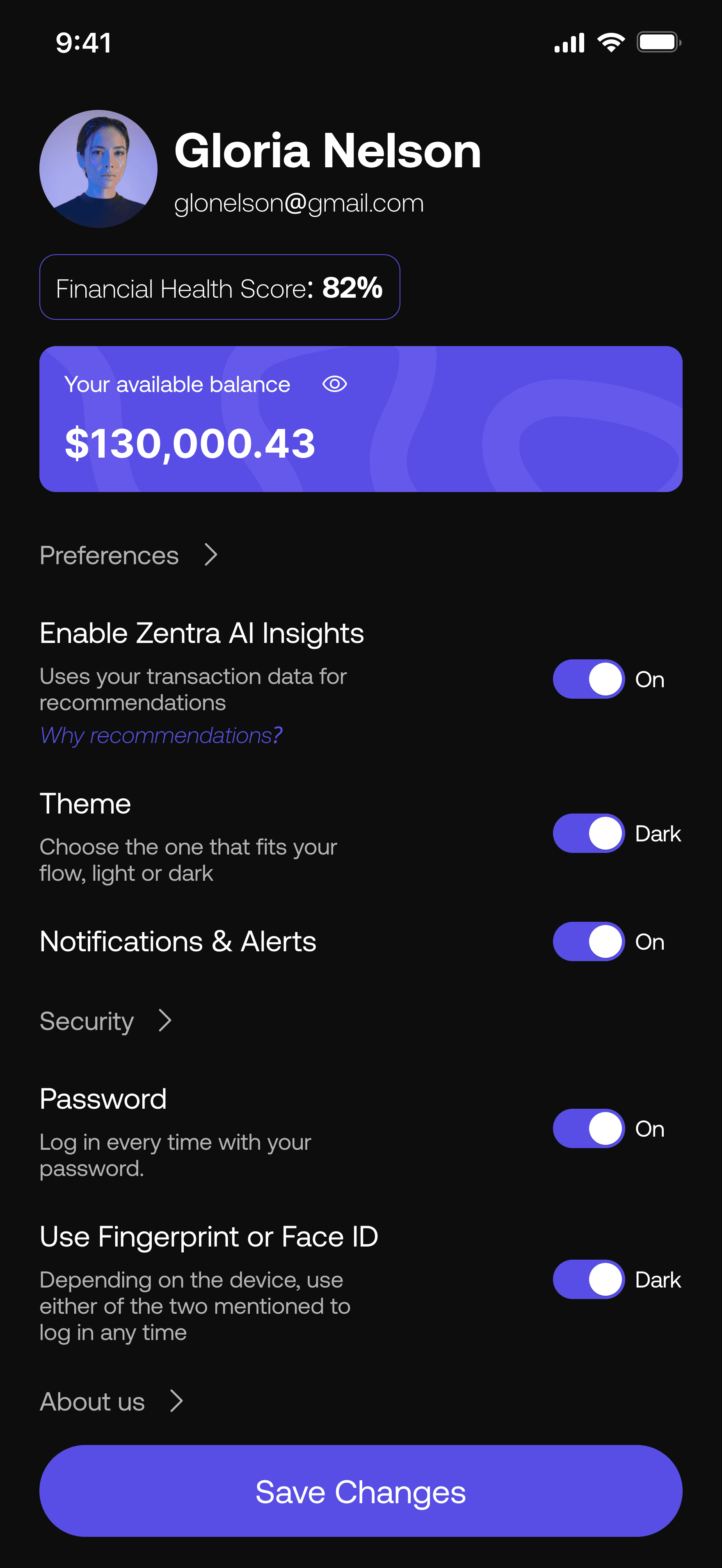
A tabbed hub for control, with the Preferences tab highlighting the "Enable AI Insights" toggle alongside other settings and notification toggles
Good to note, in the spirit of transparency this is a small reminder of why this is shown
Onboarding and Data permission page
High-Fidelity : Polishing the Vision:
Elevating wireframes into vibrant, interactive mocks, with annotations and descriptions for each key screen to demonstrate seamless fintech flows and ethical innovations.
Onboarding and Data permission page
This answers the users questions, with relation to the reason for the AI personalization permission
AI activation toggle, default off (can be changed at any time on the settings page)
The core dashboard integrates transactions, investment picks for you, and the “Products For You" module with widgets.
These are the recommended stocks Zentra gave, based on the users activity on the platform.
These are the recommended crypto Zentra gave, based on the users activity on the platform.
Focused on informed decisions, this screen features real-time charts, key stats, and the explainable AI section "Why You're Seeing This" (e.g., "Based on your interest in similar asstes").
A tabbed hub for control, with the Preferences tab highlighting the "Enable AI Insights" toggle alongside other settings and notification toggles
Good to note, in the spirit of transparency this is a small reminder of why this is shown
Onboarding and Data permission page
The High fidelity design (prototyped)
Looking Forward: Future Collaboration
According to a recent McKinsey report, over , 50% of financial institutions are already experimenting with AI-driven personalization, and adoption is expected to double within the next three years. This shows the urgency and relevance of building features like the one I designed in this project.
I am looking forward to collaborating with potential clients who want to bring this idea to life and explore how AI can drive smarter, more human-centered investment experiences. I also welcome collaboration with designers, researchers, and teams passionate about AI-powered products.
You can reach me directly at manuelbueze07@gmail.com
Reflection: Personal Takeaway
Working on this project gave me a deeper understanding of the challenges investors face when it comes to decision fatigue, trust, and clarity. Conducting the research highlighted pain points that resonated with my own experience but also expanded my perspective through real user voices. Synthesizing insights reminded me that building design solutions is not only about delivering features, but about aligning them with user trust, transparency, and control.
One honest takeaway is that while this project is still conceptual, it sharpened my ability to connect user needs with AI-driven opportunities in fintech. It also reinforced the importance of grounding ideas in real user input rather than assumptions.
I am open to discussing how this concept can be refined further, exploring other perspectives, and identifying ways it could be implemented in real-world applications.